

Combination Skin Care Routine for Indian Skin: Complete Guide

What Is the Best Skin Care Routine for Combination Skin in India?
The best combination skin care routine for Indian skin uses a gentle, low-pH cleanser, a targeted serum (Salicylic Acid + Niacinamide for the oily T-zone, Hyaluronic Acid for dry patches), a lightweight non-comedogenic moisturiser, and SPF 50 sunscreen every morning. The biggest mistake combination skin makes is treating the whole face the same — oily cheeks and a dry forehead need different interventions, not one product trying to do both jobs imperfectly.
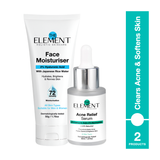
Oily nose, flaky cheeks — and one routine that handles both?
The Element 2% Salicylic Acid + 5% Niacinamide Acne Relief Serum controls T-zone sebum while the 2% Hyaluronic Acid Hydrating Serum addresses dry patches — correctly dosed actives for each zone.
Explore the Acne Relief Serum →What Is Combination Skin and How Do You Know You Have It?
Combination skin is defined by having an oily T-zone (forehead, nose, chin) alongside normal-to-dry cheeks and under-eye area. In India, combination skin is the most common skin type — the heat and humidity of Indian summers stimulate sebum in the T-zone, while indoor air conditioning and hard water create dryness on the cheeks simultaneously.
Signs You Have Combination Skin
- Nose and forehead look shiny by midday but cheeks feel tight or flaky
- Oily T-zone with visible pores on nose; smaller or no visible pores on cheeks
- Breakouts mostly in the T-zone (forehead, chin, around nose) — rarely on cheeks
- Moisturiser feels heavy on the T-zone but just right on the cheeks
- Changing seasons dramatically shift your skin — more oily in monsoon, drier in winter
Why Indian Climate Makes Combination Skin More Complex
Indian weather puts combination skin under unique pressure. During monsoon, high ambient humidity stimulates oil glands across the entire face — even the cheek areas — temporarily converting what looks like dry patches into normal skin. Then in winter, particularly in Delhi, Chandigarh, and other North Indian cities, low humidity drops the dry patches into genuinely dehydrated territory. The air conditioning effect makes this year-round in most offices.
Hard water — the mineral-rich supply across most Indian metros — further complicates things. Calcium deposits from hard water create a barrier on the skin surface that makes moisturisers less effective on dry areas while simultaneously clogging pores in the oily T-zone. This is why many combination skin types in India cycle between breakouts and flakiness without resolution.
The Complete Combination Skin Care Routine for Indian Skin
Morning Routine
Step 1: Gentle Gel or Foam Cleanser
Use a mild, low-pH (between 5-6) gel cleanser that removes overnight sebum without stripping moisture. Avoid high-foam cleansers with SLS — they clear oil from the T-zone but simultaneously strip the lipid barrier from dry cheek areas, worsening the imbalance. A brightening face wash with Niacinamide is ideal: it cleanses without aggression and preps the surface for active serums.
Step 2: Niacinamide + Salicylic Acid Serum on T-Zone
The T-zone needs active ingredients — specifically Salicylic Acid (2%), which is a BHA exfoliant that penetrates oil-filled pores to clear congestion, and Niacinamide (5%), which regulates sebum production and reduces the appearance of open pores. Apply this combination serum across the T-zone and any active breakout areas. Salicylic Acid and Niacinamide together are more effective than either alone for pore-congested skin.
Step 3: Hyaluronic Acid Serum on Dry Patches
Immediately after the acne serum, apply a Hyaluronic Acid serum specifically on dry cheek areas and under-eye zones. HA is a humectant — it draws moisture into skin cells and doesn't add oil or clog pores. At 2%, it provides meaningful hydration without the heaviness that combination skin rejects.
Step 4: Lightweight Gel or Fluid Moisturiser
Choose a moisturiser that is non-comedogenic and lightweight enough for the T-zone while still providing adequate moisture for dry patches. The correct layering order — serums before moisturiser — ensures actives are absorbed before the moisturiser creates a seal.
Step 5: SPF 50 PA++++ Sunscreen (for entire face)
UV exposure increases sebum production in oily areas and accelerates pigmentation on dry skin — making sunscreen equally important for both zones in combination skin. Use a non-greasy, non-comedogenic SPF 50 PA++++ across the entire face. The Element's Brightening Sunscreen contains 2% Niacinamide and Hyaluronic Acid — it protects from UV while maintaining hydration, making it suitable across the whole face without feeling heavy on the T-zone. Chemical vs mineral sunscreen: which is right for Indian skin?
Night Routine
Step 1: Double-Cleanse (or single cleanse if not wearing sunscreen or makeup)
At night, a thorough cleanse removes SPF, pollution, and excess sebum from the T-zone. If you wore sunscreen or makeup, consider oil cleansing first — oil-based cleansers dissolve sebum and sunscreen without stripping the skin barrier.
Step 2: Acne Serum on T-zone
Apply the SA+Niacinamide serum at night for deeper pore clearing — the skin's repair cycle during sleep makes active ingredient uptake more effective after 11 PM.
Step 3: Richer Moisturiser on Dry Areas
At night, dry patches on the cheeks benefit from a slightly richer moisturiser than daytime. Apply it only to cheeks, jawline, and under-eye areas. The T-zone can go without a night moisturiser unless it feels tight post-cleanse.
Multi-Masking for Combination Skin (Weekly)
Once a week, apply a clay or kaolin mask on the T-zone (to draw out oil and congestion) and a hydrating sheet mask or gel mask on the cheeks simultaneously. This multi-masking technique addresses both sides of the combination skin equation in a single session.
Combination Skin Routine Comparison: What Works vs What Doesn't
| Product Type | Works for Combination Skin? | Why |
|---|---|---|
| Heavy cream moisturiser (whole face) | No | Clogs pores in T-zone, triggers breakouts |
| Oil-control toner (whole face) | No | Strips already-dry cheeks further |
| Hyaluronic Acid serum (whole face) | Yes | Non-comedogenic humectant — safe on oily zones |
| 2% Salicylic Acid serum (T-zone only) | Yes | Clears congestion without drying cheeks |
| Niacinamide (whole face) | Yes | Regulates sebum AND brightens — works on both zones |
| Alcohol-heavy toner (whole face) | No | Over-dries cheeks, triggers rebound oil in T-zone |
Frequently Asked Questions
Can I use the same moisturiser for both oily and dry areas of combination skin?
Yes, if you choose a lightweight, non-comedogenic gel or fluid-texture moisturiser. The key is picking a formula that provides adequate moisture for dry areas without being heavy enough to clog pores in the T-zone. In summer, a gel moisturiser works across the whole face; in winter, you may want to apply a slightly richer product on cheeks only.
Should I use a toner for combination skin?
Only if the toner is alcohol-free and specifically contains actives like Niacinamide or low-concentration AHAs. Traditional astringent toners shrink the appearance of pores temporarily but strip the skin barrier and worsen the dry-patch problem. Skip toners unless the formula is genuinely gentle and adds value.
Why do I break out on my chin and forehead but not on my cheeks?
The T-zone has a higher density of sebaceous glands than the cheek area. Hormonal fluctuations, diet, and stress disproportionately stimulate T-zone oil production, creating ideal conditions for acne bacteria. Targeting this zone with Salicylic Acid serum addresses the root cause rather than just surface symptoms.
Is combination skin genetic or caused by environmental factors?
Both. The distribution of sebaceous glands that creates the T-zone vs dry cheek pattern is largely genetic. However, environmental factors — climate, hard water, diet, stress, and product choices — significantly influence how pronounced the combination pattern is. Indian-specific stressors can make mild combination skin behave like severe combination skin.
How often should I exfoliate combination skin?
Once or twice a week maximum — and preferably using a chemical exfoliant like 2% Salicylic Acid rather than physical scrubs. Physical scrubs create micro-tears and can spread bacteria from the T-zone to dry cheek areas. BHA exfoliation with Salicylic Acid is gentler, more targeted, and more effective for the type of congestion combination skin develops.
Products in this guide