

Kojic Acid Cream: Does It Work? Side Effects and How to Use

Kojic acid cream can fade dark spots and uneven tone by slowing melanin production, but results are gradual and it is not as strong as prescription options. Expect visible change in 8 to 12 weeks with daily sunscreen. Choose a cream at 1 to 2% with no steroid on the label, and patch test first.

Want to fade marks without a sensitising cream?
The Brightening Serum pairs 10% Niacinamide with 1% Zinc and 0.5% Bakuchiol, a correctly dosed daily option for uneven tone and post-acne marks on the face.
Explore the Brightening Serum →Kojic acid creams are among the most searched skin-lightening products in India, and they are sold everywhere from chemists to marketplaces. Some are sensible cosmetic formulas. Others carry ingredients that should never be used without a doctor. Here is how to tell them apart, what the cream can realistically do, and how to use one without irritating your skin.
What does kojic acid cream do?
Kojic acid cream reduces new pigment by blocking tyrosinase, the enzyme skin needs to make melanin. It does not remove the pigment already in your skin. Existing marks fade as skin cells turn over, which is why the process takes weeks. For the ingredient itself, our guide to kojic acid for skin covers the science in more detail.
Creams are commonly used for:
- Post-acne marks and dark spots
- Sun spots and patchy tan
- Darker areas such as the neck, elbows and underarms
- Mild melasma, usually under a dermatologist's guidance
Does kojic acid cream actually work?
Kojic acid cream works modestly, and the evidence is better for combinations than for kojic acid alone. In one Indian trial on facial melasma, 4% hydroquinone worked faster than a cream containing 0.75% kojic acid with 2.5% vitamin C, although both improved the pigmentation. The trial was small, but the pattern is a fair summary: kojic acid is a milder, cosmetic-strength option.
Three things decide whether a cream does anything for you:
- The form of kojic acid. Pure kojic acid is effective but unstable. Many creams use kojic dipalmitate, a more stable ester, and there is less human evidence for it.
- The percentage. Many labels do not state one. A European safety review set 1% as the safe limit for leave-on face and hand products, so a much higher number is not an advantage.
- Your sunscreen. UV restarts melanin production every day. Without daily sunscreen the cream is working against a process that never stops.
Kojic acid cream vs soap vs serum
The format changes how long the active stays on your skin, and contact time matters more than the name on the front.
| Format | Contact time | Best for | Main drawback |
|---|---|---|---|
| Cream | Leave-on, hours | Dry or normal skin, targeted areas | Can feel heavy on oily skin; higher chance of irritation |
| Serum | Leave-on, hours | Oily and acne-prone skin, layering | Needs a moisturiser over it |
| Soap | Under a minute | Large body areas | Little time to act; often drying |
| Body wash | Under a minute | Maintenance on the body | Slower, gentler results |
If you are weighing the bar version, read kojic acid soap: does it work. For a head-to-head on actives, see kojic acid vs niacinamide.
What are the side effects of kojic acid cream?
The common side effects are redness, stinging, dryness and peeling, and they usually settle when you reduce how often you apply it. Kojic acid is also a known contact allergen, so some people develop an itchy rash after weeks of using it without a problem.
On Indian skin, irritation has an extra cost. Inflammation can trigger new pigment, so a cream that burns may leave you darker than when you started. If your skin stings for more than a few minutes after applying it, stop and let it recover before trying again at a lower frequency.
How do you check a kojic acid cream label?
Check the ingredient list before you check the reviews, because this is where the real risk sits. Skin-lightening creams in India have repeatedly been found to contain undeclared or inappropriate ingredients. Put the tube down if you see any of these without a prescription:
- Steroids: clobetasol, betamethasone, mometasone, fluocinolone or hydrocortisone. They give fast lightening and then thinning, acne and rebound darkening. Our guide to steroid cream on the face explains what happens and how to stop safely.
- Hydroquinone: effective, but it should be used under medical supervision. Triple combination creams are prescription products for this reason.
- Mercury compounds: calomel, mercuric iodide or anything with "mercurous". Fairness cream side effects shows how to spot them.
Also be wary of any cream promising results within days. Honest pigment fading does not happen on that timeline.
How do you use kojic acid cream safely?
- Patch test first. Apply a small amount behind the ear or on the inner arm for several days. Our patch test guide walks through it.
- Start at night, three times a week. Use a pea-sized amount on clean, dry skin and increase only if your skin stays calm.
- Keep it away from the eyes, lips and broken skin.
- Moisturise afterwards to protect your barrier.
- Do not stack it with glycolic acid, retinoids or other strong actives on the same night.
- Wear broad-spectrum sunscreen every morning and reapply if you are outdoors.
- Discard a cream that has turned dark brown. Kojic acid oxidises in air and light, and a browned product has lost strength.
What can you use instead?
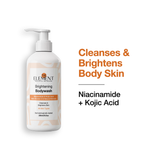
If your skin reacts to kojic acid, gentler brighteners reach a similar goal by different routes. Niacinamide slows the transfer of pigment to surface skin cells and supports the barrier, and alpha arbutin is a milder tyrosinase inhibitor. On the body, our Brightening Bodywash contains niacinamide, kojic acid and vitamin C in a rinse-off format, which is far less likely to irritate than a leave-on cream. If the concern is mostly on the face, pigmentation on the cheeks sets out a routine.
When should you see a dermatologist?
See a dermatologist if the patches are spreading, if you suspect melasma, if a spot changes shape or colour, or if you see no change after three months of consistent use. Ask a doctor before using kojic acid if you are pregnant or breastfeeding, as safety data is limited.
Frequently asked questions
Can I use kojic acid cream every day?
Many people can, once their skin has adjusted. Start three nights a week, then build up over a few weeks if there is no stinging or peeling.
How long does kojic acid cream take to work?
Most people need 8 to 12 weeks of consistent use with daily sunscreen. Deeper or older pigmentation takes longer.
Does kojic acid cream permanently lighten skin?
No. It fades excess pigment but does not change your natural skin tone. Marks can return with sun exposure if you stop protecting your skin.
Can I apply kojic acid cream on private parts or underarms?
Avoid intimate areas, where skin is thin and irritation is likely. Underarms need caution, especially right after shaving or waxing.
Can I use kojic acid cream with niacinamide?
Yes. They work through different pathways, and niacinamide's barrier support may help your skin tolerate kojic acid better.
Products in this guide